.png?x-oss-process=image/resize,h_100,m_lfit/format,webp)
.png?x-oss-process=image/resize,h_100,m_lfit/format,webp)
.png?x-oss-process=image/resize,h_100,m_lfit/format,webp)
 English
Procurement Decision Guide • Europe • Frozen Blackcurrant (IQF)
European buyers increasingly want two things at once: flexibility (smaller, more frequent orders) and stability (consistent quality, reliable cold chain, predictable documentation). This guide explains how small-batch frozen blackcurrant sourcing can meet both goals—without turning the supply chain into a daily firefight.
Why Small-Batch Frozen Blackcurrant Procurement Is Rising in Europe
Across Europe, frozen fruit procurement has shifted from “buy big, store long” to “buy smart, refresh often.” In practice, that means procurement teams are splitting annual demand into smaller shipments to reduce cash tied up in inventory, limit quality drift during long storage, and react faster to seasonality in retail, foodservice, and industrial recipes.
For frozen blackcurrant (often used in yogurts, smoothies, jams, bakery fillings, and beverage concentrates), the demand pattern can be especially volatile. Promotions, new product launches, and recipe reformulations can move quickly—while EU buyers still expect traceability, stable sensory quality, and a dependable -18°C cold chain.
Quick Snapshot: What Small-Batch Procurement Typically Changes
| Area | Traditional Larger Lots | Small-Batch Approach |
|---|---|---|
| Inventory risk | Higher (more months on hand) | Lower (fresher turnover) |
| Demand swings | Harder to react | Easier to adjust shipment frequency |
| Quality control | Fewer checks per year | More frequent COA verification & trend tracking |
| Packaging options | Mostly standard bulk | More room for OEM label, mixed SKUs |
The key is doing it without creating gaps in supply. That’s where refined supplier-side planning and disciplined cold-chain execution become non-negotiable.

Building Flexibility Without Sacrificing Stability: The Supplier-Side Playbook
Small-batch buying works best when the supplier is set up to deliver repeatability. In Europe-facing frozen fruit programs, “flexibility” is not a vague promise—it’s a set of operating controls that allow order sizes to change while keeping quality and documentation consistent.
1) Lot planning that matches European receiving reality
Many EU importers prefer predictable receiving slots and minimal surprises at the cold store. A practical structure is a rolling forecast (e.g., 8–12 weeks) with confirmed quantities for the next 2–4 weeks. This is where small-batch procurement becomes a system, not an exception.
- Set a baseline specification: varietal profile, IQF grade, defect tolerance, brix/acid range where relevant, and foreign matter standard.
- Define shipment cadence: for example, monthly or bi-weekly replenishment to reduce stockouts.
- Use lot mapping: each shipment linked to harvest/production lots for quick trace-back.
2) OEM/private label packaging that still stays compliant
For European retailers and brand owners, OEM packaging is often a growth lever—especially for smoothie packs, bakery ingredients, and foodservice formats. The procurement advantage of small batches is the ability to test packaging and labeling with reduced risk before scaling.
OEM Packaging Checklist (Buyer-Friendly)
Operational
- Pack size options (e.g., 1 kg, 2.5 kg, 10 kg)
- Carton palletization & container loading plan
- Lead time for artwork approval and printing
Compliance
- EU labeling elements (ingredients, net weight, lot code)
- Allergen statement where applicable (cross-contact policy)
- Country of origin & storage instruction (-18°C)
When suppliers treat OEM as a controlled process—rather than a one-off favor—buyers get faster approvals, fewer relabeling issues, and a smoother launch into EU channels.
The -18°C Cold Chain: What Actually Protects Frozen Blackcurrant Quality
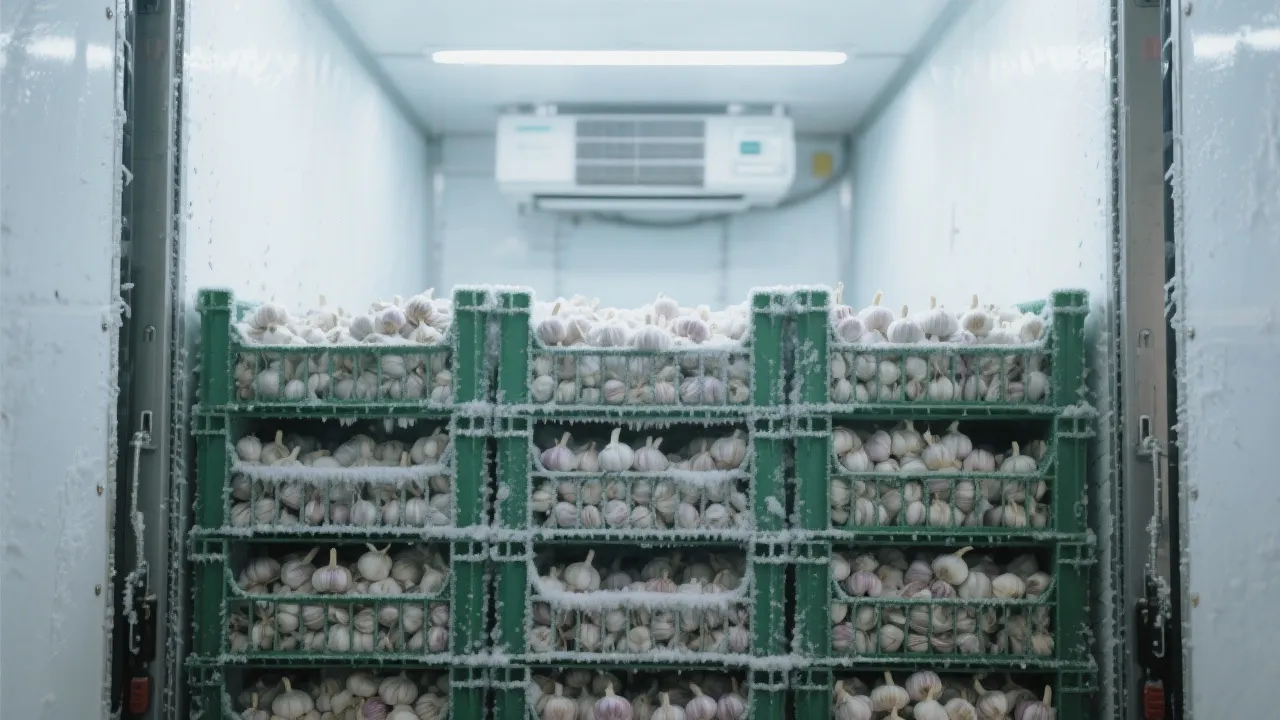
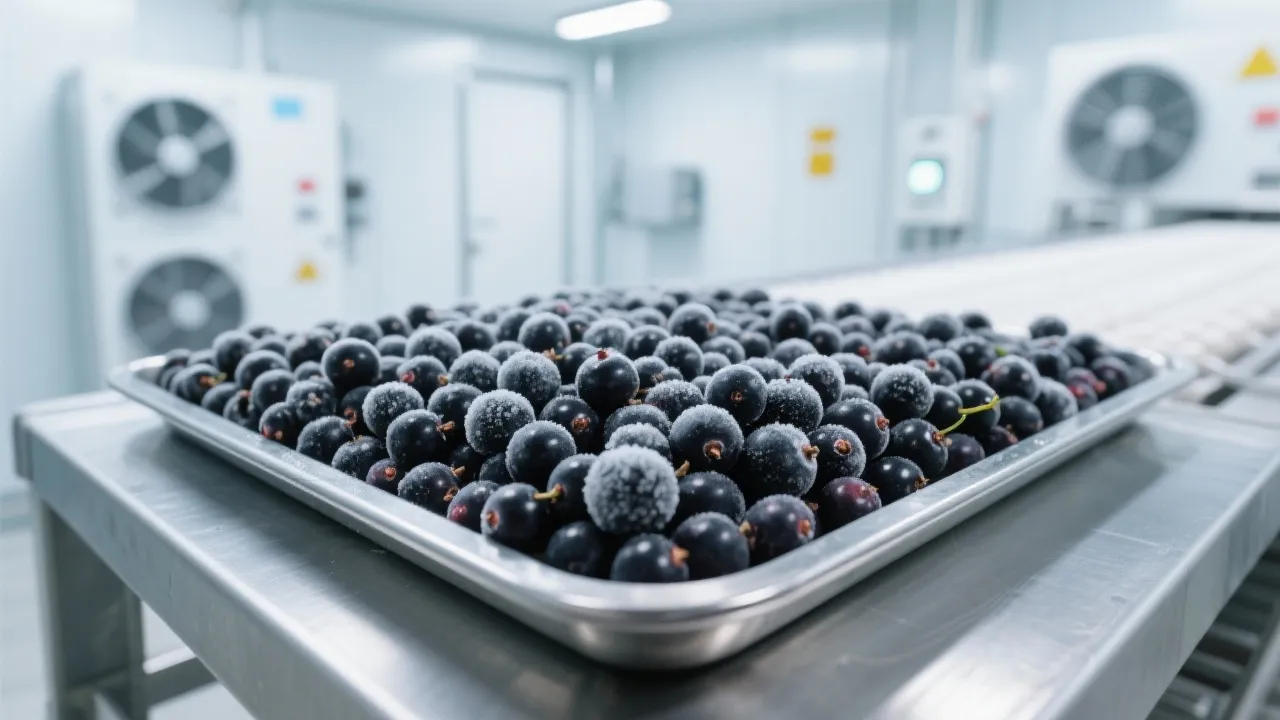
Frozen blackcurrant quality is not only about how it is processed—it’s about how consistently it is kept frozen. Repeated micro-thawing can increase drip loss, clumping, and color degradation. For European buyers, the difference between a “good shipment” and a “problem shipment” often comes down to measurable temperature discipline.
Key technical controls buyers should request
- Continuous temperature monitoring: a data logger placed in the cargo area (not only at the door). Many EU importers target an acceptable range around -18°C with short, controlled excursions, depending on product and route risk.
- Pre-cooling and loading discipline: loading into a properly pre-cooled reefer container and minimizing door-open time reduces “warm spots” that can cause partial thaw.
- Route planning and handover control: fewer transshipments and verified cold-store handovers reduce temperature variance.
- Packaging + pallet stability: stable pallet patterns and airflow channels improve temperature uniformity.
Practical benchmark used in many frozen fruit programs: core product at or below -18°C at dispatch and verified at arrival, supported by temperature records. This is one of the simplest ways to prevent disputes and accelerate acceptance at EU cold stores.

Using Third-Party Testing to Win Trust (and Speed Up EU Internal Approvals)
In European procurement, trust is built with documents that stand up to audits. Internationally recognized lab reports and a clean, consistent COA (Certificate of Analysis) can reduce onboarding friction—especially for new suppliers or new origins.
What buyers typically ask to see for frozen blackcurrant
| Document / Data | Purpose in EU Procurement | How it reduces risk |
|---|---|---|
| Microbiology panel (common food safety indicators) | Supplier approval & incoming QC alignment | Prevents rejection and re-testing delays |
| Pesticide residue screening (EU-facing) | Regulatory compliance and retailer specs | Supports due diligence and audit trails |
| Foreign matter control records / metal detection | Food safety system validation | Reduces recall exposure and complaint rates |
| Traceability & lot coding procedure | Importer ERP integration | Faster root-cause analysis if issues arise |
A common pattern in Europe is that a procurement manager is not the only decision-maker. Quality assurance, regulatory, and sometimes a retail customer’s technical team may also be involved. Clear third-party testing helps those stakeholders align faster.
Useful KPI Targets (Reference Ranges Used in Practice)
Targets vary by buyer specification, application, and origin. Still, procurement teams often track these for stability across small batches:
Quality consistency
- Defect rate trend stable within ±10–15% across lots
- Clumping complaints near 0 when maintained at -18°C
- On-time dispatch performance above 95%
Supply chain reliability
- Temperature log availability for 100% of shipments
- Document accuracy (invoice/packing list/COA) above 99%
- Claim resolution cycle under 10 business days
Case Scenario: From “Annual Bulk Buy” to Small-Batch Replenishment
Consider a mid-size European beverage producer using frozen blackcurrant as a key ingredient. In the past, the team purchased a large seasonal lot and held inventory for extended periods. The result was predictable on paper but painful in reality: warehouse pressure, cash locked in stock, and inconsistent fruit behavior during production.
After moving to a small-batch replenishment model, the procurement plan shifted to shorter cycles supported by tighter lot control, consistent COAs, and a standardized cold-chain evidence pack (temperature logs + dispatch records). Operationally, the biggest change was not “ordering less”—it was ordering with discipline: forecast windows, confirmation rules, and repeatable acceptance criteria.
Mini Workflow: A Practical Small-Batch Purchase Cycle
| Step | What Happens | Buyer Benefit |
|---|---|---|
| 1. Spec lock | Agree on grade, defects, packing formats, labeling | Fewer disputes, easier incoming QC |
| 2. Rolling forecast | Provide 8–12 week outlook, confirm next 2–4 weeks | Flexibility with controlled planning |
| 3. Pre-shipment QC | COA + photos/videos + lot info (as agreed) | Higher confidence before container booking |
| 4. Cold chain evidence | Temperature logger + dispatch temperature checks | Faster receiving and claim prevention |
| 5. Post-arrival feedback | Trend tracking per lot and rapid corrective actions | Continuous improvement over the season |
Over time, this kind of structure turns “small-batch” from an emergency choice into a scalable European procurement strategy.
Common Buyer Questions (FAQ) for Frozen Blackcurrant Small Orders
Can small batches still be consistent from lot to lot?
Yes—if the supplier has stable sorting/grading controls, lot mapping, and a repeatable testing routine. Consistency improves when each shipment carries a clear COA and traceable lot code, and when acceptance criteria are aligned before the first shipment.
What matters most in -18°C transport for avoiding claims?
Continuous temperature records, correct pre-cooling, disciplined loading, and documented handovers. Buyers typically see fewer disputes when temperature logs are provided for every shipment and reviewed immediately upon arrival.
Is OEM/private label possible on smaller quantities?
Often, yes. The practical approach is to standardize the inner product specification first, then apply OEM packaging as a controlled process (artwork approval, label compliance checks, and palletization plan). Small batches can be ideal for market testing before scaling.
Which compliance documents speed up EU onboarding?
A clean COA, traceability procedure, and credible third-party lab reports (especially for EU-facing pesticide residue screening) typically reduce internal approval cycles. Procurement teams also benefit from standardized shipment document packs to avoid customs and receiving delays.
Need a Flexible, Audit-Ready Sourcing Plan for Frozen Blackcurrant in Europe?
A tailored plan can combine small-batch ordering, OEM packaging options, -18°C cold chain evidence, and the right testing documentation—so procurement stays agile without losing stability. Share your target application, preferred pack size, and delivery port to receive a practical proposal.



.jpg?x-oss-process=image/resize,h_800,m_lfit/format,webp)